AI Implementation in Business: Why Approach Matters More Than Technology

Many leaders assume that AI implementation in business is a technology challenge.

However, that assumption is misleading.

Most businesses do not struggle because tools are complex or systems are advanced. Instead, they struggle because of how they approach AI from the start.

AI Is Not a One-Time Implementation

First, a common mistake in AI implementation in business is treating it as a one-time setup.

Companies often select a tool, integrate it into workflows, and expect immediate transformation. However, when results do not appear quickly, momentum fades and the initiative stalls.

AI does not work like that.

Instead, it evolves over time. It requires continuous learning, refinement, and alignment with business goals. Without this mindset, even the best tools fail to deliver results.

Lack of Clarity Slows Down AI Success

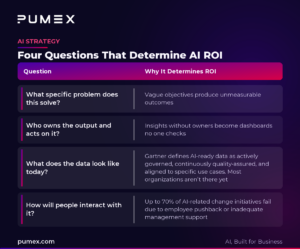
Another major issue in AI implementation in business is unclear objectives.

For example, many businesses begin with broad goals such as improving efficiency or enhancing customer experience. Although these goals sound reasonable, they are too vague to drive meaningful execution.

To move forward effectively, businesses must focus on specific questions:

  • Where is time being lost?
  • Which processes create frequent errors?
  • What decisions face delays or inconsistency?

When teams answer these questions, they can apply AI with precision. As a result, businesses shift from scattered efforts to high-impact use cases that deliver measurable results.

The Human Factor in AI Implementation

At the same time, the success of AI implementation in business is not just technical. It is deeply human.

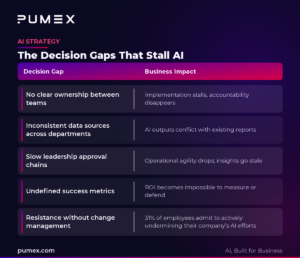
Teams often feel uncertain when AI is introduced. For instance, employees may fear replacement, hesitate to trust automation, or struggle to understand how AI fits into daily work. If leaders ignore these concerns, resistance grows and adoption slows down.

Therefore, leadership plays a critical role.

Leaders must shift the narrative from replacement to enablement. In other words, they need to position AI as a tool that supports people rather than replaces them. To build confidence, organizations should invest in training, communication, and team involvement.

Avoid the Trap of Over-Automation

At this stage, businesses must also avoid over-automation in AI implementation in business.

Not everything should be automated.

In fact, over-automation can remove the human judgment and creativity that differentiate strong businesses from average ones. Instead, the goal should be to automate the right tasks.

For example, AI works best in:

  • Repetitive tasks
  • Data-heavy processes
  • Pattern recognition

On the other hand, humans remain essential for:

  • Strategic thinking
  • Relationship building
  • Creative direction

Ultimately, the balance between these areas creates real value.

What Successful Businesses Do Differently

So, what do successful companies do differently in AI implementation in business?

They do not chase every new tool or trend. Instead, they focus on building systems where AI enhances human capability. Additionally, they test, learn, and adapt continuously. Most importantly, they align AI initiatives with clear business outcomes.

At Pumex, this approach drives every AI initiative. The focus is not just on technology. Rather, it is on building systems that evolve and deliver consistent value over time.

AI does not fail businesses.

Instead, poor approach does.

Therefore, in AI implementation in business, the way you approach it determines whether it becomes a growth engine or just another unused tool.

The Real ROI of AI Isn’t Cost Cutting. It’s Clarity!

When businesses first explore AI, the conversation almost always starts with cost reduction. But the real discussion around AI ROI in business goes far beyond cutting expenses.

“How many hours can we save?”
“How many roles can we automate?”
“How much cheaper can we operate?”

These are valid questions. But they miss the bigger picture.

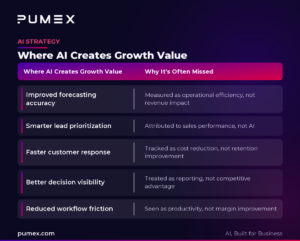
The real return on investment from AI is not just about doing things cheaper. It is about doing the right things with greater clarity.

Today, businesses are not struggling with a lack of data. They are struggling with too much of it. Marketing dashboards, customer feedback, sales reports, and operational metrics are constantly collected and stored. Still, decision-making remains slow and uncertain.

This is where AI changes the game.

AI does more than collect data. It interprets it. It highlights patterns, surfaces anomalies, and provides direction. Instead of spending hours figuring out what is happening, teams can focus on why it is happening and what to do next.

In customer experience, for example, AI analyzes interactions across multiple channels and identifies friction points that often go unnoticed. It shows why customers drop off, what messaging works, and where expectations are not being met.

This level of clarity reshapes how businesses operate.

Marketing shifts from guesswork to precision. Sales teams prioritize leads using real insights instead of assumptions. Operations move from reactive responses to proactive planning.

However, there is a catch.

Clarity only creates value when businesses act on it.

Many organizations implement AI tools, generate insights, and then fall back into old habits. Teams review reports, discuss findings, and move on without taking meaningful action. In these cases, AI turns into an expensive reporting layer instead of a growth driver.

To unlock real AI ROI in business, companies must integrate AI into everyday decision-making. This requires redefining workflows, aligning teams, and trusting data-driven insights while still applying human judgment.

Alignment also plays a critical role.

AI brings different functions together by creating a shared view of performance and priorities. When marketing, sales, and operations work from the same insights, collaboration improves and execution becomes more consistent.

At Pumex, the focus is on using AI to deliver clarity where it matters most. Not just in dashboards, but in real business decisions. Because growth does not come from having more information. It comes from understanding what that information means.

Once that clarity is in place, efficiency improves, performance strengthens, and scalable growth follows.

AI Is Not the Strategy. It’s the Multiplier

There’s a quiet misconception spreading across boardrooms right now: that adopting AI equals innovation.

It doesn’t!!

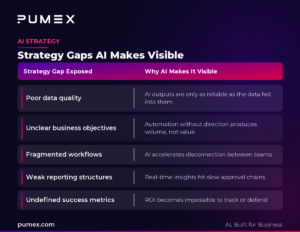
AI, on its own, is not a strategy. It’s a multiplier. And what it multiplies depends entirely on what already exists inside your business.

If your processes are inefficient, AI will make them faster inefficient processes. If your messaging lacks clarity, AI will help you scale that confusion across channels at an impressive speed. But if your fundamentals are strong, that’s where AI starts to become transformative.

The real opportunity lies not in using AI, but in understanding where it fits.

Most businesses begin their AI journey from the wrong end. They ask, “Where can we use AI?” instead of asking, “Where are we losing time, precision, or consistency?” That shift in questioning matters. Because AI performs best when it solves friction, not when it is forced into workflows for the sake of novelty.

Take marketing as an example. AI tools today can generate content, automate campaigns, and even analyze customer behavior in real time. But businesses that see results are not the ones using every tool available. They are the ones who have clarity on their audience, their positioning, and their voice. AI simply helps them execute faster and test smarter.

Another critical factor is decision-making. AI can process data at a scale humans simply cannot match. It can identify patterns, predict trends, and surface insights that would otherwise remain buried. But the decision still belongs to humans. And that’s where many organizations hesitate. They either over-rely on AI outputs or ignore them altogether.

The balance is not technical. It’s cultural.

Leaders need to build environments where AI is treated as a collaborator, not a replacement. Teams need to understand that using AI is not about reducing human involvement but enhancing it. When used correctly, AI frees up time from repetitive tasks and allows people to focus on strategy, creativity, and problem-solving.

There’s also a competitive reality that cannot be ignored. Businesses that learn to integrate AI effectively will move faster, adapt quicker, and operate more efficiently. Not because AI is inherently superior, but because they are leveraging it with intent.

The gap will not be between businesses that use AI and those that don’t. It will be between businesses that use AI thoughtfully and those that use it blindly.

At Pumex, the focus is not on pushing AI adoption for the sake of it. It’s about identifying where AI creates real, measurable impact. Whether that’s improving operational efficiency, enhancing customer experience, or enabling better strategic decisions, the goal remains the same: progress that is both scalable and sustainable.

Because in the end, AI does not define your business.

How you use it does.