You approved the budget. The tools are live. The demos were impressive. What about the decision making? Ever wondered that AI decision-making is real?
So why is ROI still invisible?
Nearly 74% of organizations have yet to achieve tangible value from AI initiatives despite record investment. The gap isn’t the software. It’s the decision-making infrastructure underneath it.
AI doesn’t fail in isolation. It fails inside organizations where ownership is unclear, priorities conflict, and approvals move slower than the insights AI generates. Fix the tech without fixing that, and you’re accelerating toward the same wall, just faster.
The Decision Layer No One Talks About
Most AI implementation guides focus on tool selection, integrations, and data pipelines. These matter. But they’re rarely why initiatives stall.
Companies without a formal AI strategy report only 37% success. Companies with a well-defined strategy report 80%. That 43-point gap isn’t a technology gap. It’s a leadership and alignment gap.
Wharton’s 2025 enterprise AI research is direct: organizational readiness initiatives like leadership alignment, governance, and change management set the pace. Not tools. The organizations pulling ahead aren’t running better software. They’re running clearer decision structures.
Related: AI Implementation in Business: Why Approach Matters More Than Technology, where Pumex explores how businesses approach AI from the start shapes everything that follows.
More Data, More Paralysis
Here’s the counterintuitive trap. AI floods teams with insights. But without defined ownership and workflow clarity, more information creates more hesitation and not faster decisions.
Deloitte’s 2025 survey found that one in four organizations cite inadequate data foundations and unclear governance as their primary barrier to AI ROI. Even among companies already using AI daily.
The pattern holds across industries. Teams receive dashboards, alerts, and automated recommendations. But without a clear process for who acts on what, by when, those insights expire in inboxes.
The Decision Gaps AI Exposes
AI doesn’t create organizational dysfunction. It reveals it fast.
Here are the gaps that consistently surface during implementation:
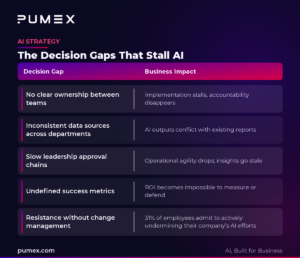
These aren’t AI problems. They’re organizational problems that AI makes impossible to hide.
Treat AI as Decision-Making Infrastructure, Not Automation
The companies generating real, sustained ROI from AI share one approach. They embed AI into how decisions are made and not just how work gets done. Hence AI decision-making gets the edge.
That means surfacing risks earlier. Improving forecast confidence. Reducing ambiguity in planning. Giving leaders faster operational visibility. Not replacing human judgment but sharpening it.
Among high-performing organizations, 88% of employees and 97% of executives report directly benefiting from AI. Not because the tools are smarter. Because the workflows were redesigned to make AI recommendations actionable.
Three Things to Fix Before the Next AI Initiative
- Map decision ownership explicitly.Every AI use case needs a named owner, someone accountable for acting on the output. Without this, recommendations become suggestions no one isobligated to follow.
- Align data sources across departments.If finance and operations pull from different datasets, AI generates contradictory guidance. Shared data governance is prerequisite, not optional.
- Redesign approval workflows.AI moves at machine speed. If acting on a recommendation still requires threesign-offs, you’ve engineered out the speed advantage. Reduce friction before deployment, not after.
Work With a Team That Gets Both Sides
At Pumex Computing, we design and implement AI, data analytics, and machine learning solutions built around how your organization makes decisions and not just how the platform documentation says it should.
With a 95% client retention rate and a proven track record across enterprise and government organizations, we help teams move from AI experimentation to measurable operational impact.
Sources:
- Deloitte AI ROI Survey 2025
- Wharton/GBK Collective Enterprise AI Report, October 2025
- WRITER Enterprise AI Adoption Report 2025
- McKinsey Global AI Survey
- Accenture AI Readiness Research
- MIT Sloan Management Review