


Table of Contents
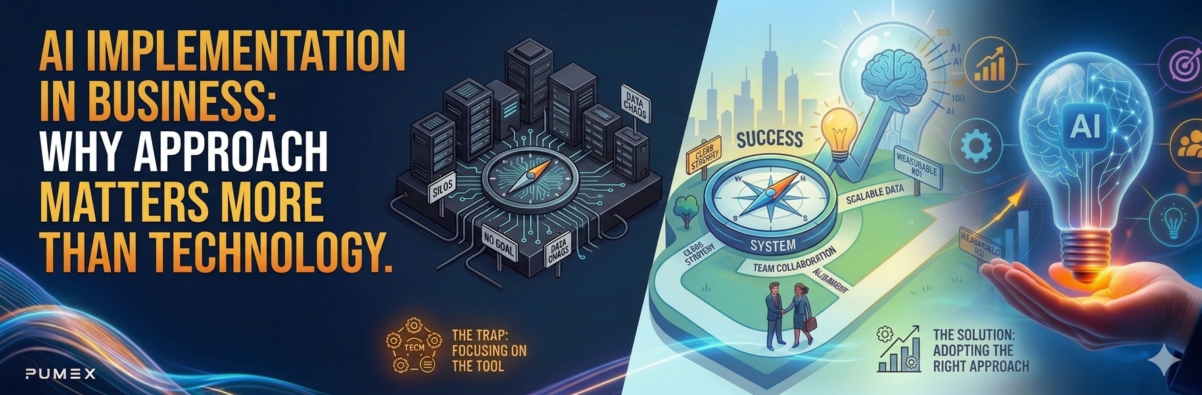
Many leaders assume that AI implementation in business is a technology challenge.
However, that assumption is misleading.
Most businesses do not struggle because tools are complex or systems are advanced. Instead, they struggle because of how they approach AI from the start.
AI Is Not a One-Time Implementation
First, a common mistake in AI implementation in business is treating it as a one-time setup.
Companies often select a tool, integrate it into workflows, and expect immediate transformation. However, when results do not appear quickly, momentum fades and the initiative stalls.
AI does not work like that.
Instead, it evolves over time. It requires continuous learning, refinement, and alignment with business goals. Without this mindset, even the best tools fail to deliver results.
Lack of Clarity Slows Down AI Success
Another major issue in AI implementation in business is unclear objectives.
For example, many businesses begin with broad goals such as improving efficiency or enhancing customer experience. Although these goals sound reasonable, they are too vague to drive meaningful execution.
To move forward effectively, businesses must focus on specific questions:
- Where is time being lost?
- Which processes create frequent errors?
- What decisions face delays or inconsistency?
When teams answer these questions, they can apply AI with precision. As a result, businesses shift from scattered efforts to high-impact use cases that deliver measurable results.
The Human Factor in AI Implementation
At the same time, the success of AI implementation in business is not just technical. It is deeply human.
Teams often feel uncertain when AI is introduced. For instance, employees may fear replacement, hesitate to trust automation, or struggle to understand how AI fits into daily work. If leaders ignore these concerns, resistance grows and adoption slows down.
Therefore, leadership plays a critical role.
Leaders must shift the narrative from replacement to enablement. In other words, they need to position AI as a tool that supports people rather than replaces them. To build confidence, organizations should invest in training, communication, and team involvement.
Avoid the Trap of Over-Automation
At this stage, businesses must also avoid over-automation in AI implementation in business.
Not everything should be automated.
In fact, over-automation can remove the human judgment and creativity that differentiate strong businesses from average ones. Instead, the goal should be to automate the right tasks.
For example, AI works best in:
- Repetitive tasks
- Data-heavy processes
- Pattern recognition
On the other hand, humans remain essential for:
- Strategic thinking
- Relationship building
- Creative direction
Ultimately, the balance between these areas creates real value.
What Successful Businesses Do Differently
So, what do successful companies do differently in AI implementation in business?
They do not chase every new tool or trend. Instead, they focus on building systems where AI enhances human capability. Additionally, they test, learn, and adapt continuously. Most importantly, they align AI initiatives with clear business outcomes.
At Pumex, this approach drives every AI initiative. The focus is not just on technology. Rather, it is on building systems that evolve and deliver consistent value over time.
AI does not fail businesses.
Instead, poor approach does.
Therefore, in AI implementation in business, the way you approach it determines whether it becomes a growth engine or just another unused tool.