



Table of Contents
- Most AI investment conversations start in the wrong room.
- What the Cost Center Mindset Actually Costs You
- The Reframe: From Expense to Capability
- Why ROI Takes Longer Than Most Expect, and Why That’s Fine
- Where the Value Actually Accumulates
- Technology Alone Still Doesn’t Deliver It
- The Mindset Shift That Precedes the ROI Shift
Most AI investment conversations start in the wrong room.
They begin in finance with budget approvals, implementation timelines, and expected cost savings. Those conversations matter. But when cost reduction becomes the primary frame for AI investment ROI, something important gets lost.
The businesses generating real returns from AI aren’t just cutting costs. They’re using AI to grow revenue, improve decision quality, and build operational advantages their competitors are still trying to catch up to.
PwC’s 2026 Global CEO Survey found that 56% of CEOs report no revenue or cost benefits from AI. That’s not a technology problem. It’s a framing problem.
What the Cost Center Mindset Actually Costs You
When AI is evaluated purely as an operational expense, the questions organizations ask become self-limiting.
How much will this cost? How quickly can it pay back? What headcount can it replace?
These are legitimate questions. But they measure AI against the wrong benchmark. They treat intelligence as infrastructure, something to be depreciated, not compounded.
BCG’s analysis of over 1,250 firms found that the top 5% of organizations achieving AI value at scale generate 1.7x revenue growth and 3.6x total shareholder return compared to laggards. The gap between those two groups isn’t budget. It’s intent.
The companies in that top 5% aren’t asking how much AI costs. They’re asking what it makes possible.
The Reframe: From Expense to Capability
This shift is subtle, but it changes everything downstream.
A customer support system powered by AI reduces response time. That’s a cost metric. But it also improves retention, reduces churn, and protects revenue. That’s a growth metric. Both are real. Most organizations only measure the first one.
In 2025, 56% of business leaders reported revenue growth directly attributable to AI. The use cases driving those results share one pattern: AI was connected to an outcome the business already cared about, not deployed as a standalone efficiency exercise.
That connection between AI capability and business outcome is the reframe. It doesn’t require a larger budget. It requires a different starting question.
Why ROI Takes Longer Than Most Expect, and Why That’s Fine
One of the most common reasons AI gets stuck in cost center thinking is timeline mismatch.
Deloitte’s 2025 survey of 1,854 executives found that most organizations achieve satisfactory AI investment ROI within two to four years. That’s significantly longer than the seven-to-twelve-month payback period typically expected for technology investments. Only 6% reported payback in under a year.
Abandoning projects at month eight because they haven’t delivered cost savings yet is one of the most reliable ways to ensure they never do. The businesses treating AI as a long-term capability investment are the ones compounding value while others wait for the first dashboard to pay for itself.
Where the Value Actually Accumulates
The strongest AI returns rarely come from a single dramatic transformation. They come from smaller, consistent improvements across multiple operational areas, compounding quietly over time.
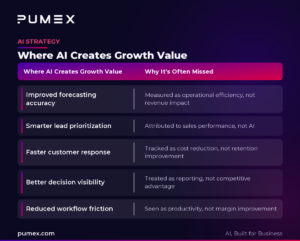
Each of these individually looks modest. Together, they shift the economics of how a business operates, and that shift is what turns AI from a line item into a leverage point.
Technology Alone Still Doesn’t Deliver It
None of this happens by buying the right tools.
Snowflake’s 2025 research found that 92% of organizations actively using AI reported their investments paying for themselves, returning an average of $1.41 for every dollar spent. Actively using means embedded in daily operations, not sitting in a pilot.
The organizations achieving those returns have done the harder work: process alignment, employee adoption, data governance, and clear ownership of AI outputs. That’s the difference. Not spending more. Integrating more deliberately.
The Mindset Shift That Precedes the ROI Shift
The companies turning AI into a profit driver didn’t get there by optimizing their cost center logic. They got there by stopping that conversation and starting a different one.
Not what can we automate, but where do we want to compete differently in three years, and how does AI get us there?
That question leads to use cases with revenue attached. It leads to integrations that compound. It leads to AI that feels less like overhead and more like operating advantage.
The shift from cost center to profit driver doesn’t start with the technology. It starts with how the investment is framed, and what it’s being asked to do.
At Pumex, that’s typically where the most useful conversations begin. If yours hasn’t started yet, it’s worth a conversation.
Sources:
- PwC Global CEO Survey 2026
- BCG The Widening AI Value Gap, September 2025
- Deloitte AI ROI: The Paradox of Rising Investment and Elusive Returns, October 2025
- Google Cloud AI ROI Research 2025
- Snowflake/Enterprise Strategy Group Radical ROI of Generative AI, April 2025