



Table of Contents
The pressure to adopt AI is real. Competitors are announcing it. Vendors are promising transformation. Boards are asking about roadmaps.
So, when the Board, or CEO hands down a directive, organizations move fast. They license tools, stand up pilots, and automate workflows, often before they’ve answered one critical question: will AI make this business problem more efficient, save time and create an ROI?
That omission is expensive. In 2025, 42% of companies scrapped most of their AI initiatives – up sharply from just 17% the year before. It wasn’t necessarily the technology that failed them. A large part of the time, it’s the context that fails: a clear understanding of the problem, the objective, and how AI fits into how the business operates. But context alone isn’t the full picture either.
Even organizations that identify the right problem often hit a second, less visible wall: the gap between what they understand and what they’re organizationally capable of executing. That gap between context and capability is where well-resourced, well-intentioned projects quietly collapse, and it deserves its own conversation.
Automating a Broken Process Makes It Break Faster
This is the most common, and most avoidable, AI implementation mistake.
If a customer support workflow is fragmented, an AI chat layer makes it respond faster while still delivering inconsistent experiences. If sales data is incomplete, predictive tools generate confidently wrong forecasts. If approval chains are slow, AI surfaces insights that sit unread until they’re irrelevant.
Organizations investing in AI resources allocate 70% of their AI budget toward people and processes, not technology alone. The ones skipping that step are the ones generating the failure statistics.
MIT’s Project NANDA found that 95% of organizations deploying generative AI saw zero measurable P&L impact. Not because the models underperformed. Because the operational foundation wasn’t there to turn outputs into action.
The Wrong Starting Question
Most organizations begin AI implementation by asking: where can we use AI?
That question almost always leads to the wrong answer.
The more productive starting point is: where are we losing time, accuracy, or consistency right now? That question surfaces the use cases where AI creates measurable, defensible value. The first question leads to pilots that stall: 88% of AI pilots never make it to production.
Only 15% of US employees report that their workplaces have communicated a clear AI strategy, yet 92% of executives planned to increase AI spending within three years. That gap between planning intent and operational clarity is where budgets disappear.
Related: AI Won’t Fix Your Strategy. But It Will Expose the Gaps on why AI surfaces organizational weaknesses before it delivers value. Before you thought about AI doing it, people were reviewing the data, assessing the gaps, and creating the interpretation based on the known gaps. AI doesn’t have the ability that people do, to complete data sets and make intuitive leaps. The foundation of AI is a trusted data source.
What “Business Context” Actually Means
It’s not a philosophy. It’s four operational questions that need answers before deployment begins.
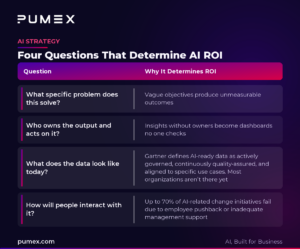
These aren’t implementation details. They’re the conditions that determine whether AI creates value or just cost.
Human Judgment Isn’t Optional
One of the most persistent misconceptions around AI is that it reduces the need for human involvement.
It doesn’t. It changes what human involvement looks like.
Customer behavior shifts. Market conditions change. Internal priorities evolve. AI can identify patterns in data. It can’t interpret what those patterns mean in the context of a business that is still changing. The failure mode is rarely that the AI doesn’t work. It’s that organizations underestimate what it takes to run AI safely, reliably, and continuously.
Businesses generating durable ROI from AI maintain a clear division: automation handles repetitive analysis at scale, humans handle interpretation, judgment, and decisions that carry real consequences.
That balance isn’t a limitation. It’s the design.
The AI Implementations That Work Best Are Often Invisible
The most effective AI deployments rarely look dramatic from the outside. They don’t announce themselves. They quietly reduce reporting noise, improve access to operational data, accelerate collaboration between teams, and surface problems earlier than manual processes ever could.
That invisibility is intentional. When AI is genuinely embedded in how a business operates, rather than bolted on top of it, it stops feeling like a technology initiative and starts feeling like how work gets done.
That shift is the difference between AI as a subscription cost and AI as a genuine operational advantage.
Context First. Technology Second.
IBM’s research found that enterprise-wide AI initiatives achieved an ROI of just 5.9% despite incurring a 10% capital investment. This is for organizations that led with tools before defining business context.
The pattern in every credible piece of research is consistent: the organizations extracting real value from AI aren’t the fastest to deploy. They’re the most deliberate about what they’re deploying it for.
If your AI initiatives are producing cost without clarity, the technology isn’t the place to start looking. The business context underneath it usually is.
That’s a diagnostic conversation worth having, and one Pumex has helped enterprise and government organizations work through for over a decade. Reach out if it’s useful.
Sources:
- S&P Global AI Initiative Report 2025
- MIT Project NANDA GenAI Divide Report, July 2025
- Gartner AI-Ready Data Research, February 2025
- Gallup US Workplace AI Survey 2024
- McKinsey Global AI Survey 2025
- IBM Institute for Business Value
- CapTech/Harris Poll Executive AI Research, August 2025