



Table of Contents
Leadership teams are under real pressure right now.
Competitors are announcing AI initiatives. Boards are asking about AI roadmaps. And most organizations are somewhere between “we’re exploring it” and “we’ve already spent money on it.”
Here’s what rarely gets said out loud: AI doesn’t create strategy gaps. It finds the ones you already have and puts them on full display. That’s not a warning against AI adoption. It’s the most important thing to understand before you scale it.
AI Amplifies What’s Already There
Think of AI as a multiplier. Not of potential, but of reality.
When workflows are clean, data is consistent, and teams are aligned, AI compounds those strengths. Speed increases. Visibility improves. Decisions get sharper.
But when fragmented systems, unclear priorities, and siloed departments are the norm, AI amplifies that too. Faster confused reports. More automated noise. Wider gaps between what the data says and what teams can act on.
According to a 2024 PwC survey, nearly half of executives reported that data quality and internal integration challenges were their primary barriers to AI adoption, not the technology itself. AI doesn’t fail. It reflects.
The Question Most Organizations Ask Too Late
Most businesses begin AI implementation by asking: where can we use AI?
That’s the wrong starting point. The more productive question is: where are we losing time, precision, or consistency right now? That question leads to use cases where AI creates measurable impact. The first question leads to pilots that stall six months in.
BCG research found that only 26% of companies have developed the capabilities needed to move beyond AI pilots and generate value at scale. The barrier isn’t access to tools. It’s the absence of a clear operational foundation to build on.
Related: AI Is Not the Strategy. It’s the Multiplier on why AI performs best when the fundamentals are already working.
What AI Consistently Surfaces
The gaps AI exposes are predictable. They show up across industries, company sizes, and sectors.
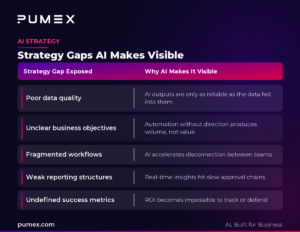
Source: PwC AI Business Survey 2024 – BCG AI Maturity Report
These aren’t AI problems. They’re organizational problems. AI just removes the cover.
What Businesses Getting ROI Actually Do Differently
The organizations generating real, sustainable value from AI share a pattern. They don’t start with the tool. They start with the question. Before scaling, they ask:
What operational problem are we solving? Not “how do we use AI,” but which specific friction point, bottleneck, or inconsistency is costing time or margin.
Who owns the outcome? Every AI use case needs accountability. Insights without owners become dashboards no one checks.
What does success look like in 90 days? Vague goals produce vague outcomes. Clear metrics create clear feedback loops.
MIT Sloan Management Review consistently finds that organizations combining AI adoption with operational redesign, and not just technology deployment, achieve stronger, more durable outcomes.
The Real Competitive Divide
The gap forming right now isn’t between companies that use AI and those that don’t. It’s between companies that deploy AI with operational clarity and those that deploy it hoping AI will create that clarity for them.
It won’t.
But when the foundation is right: when data governance is solid, ownership is clear, and objectives are defined, AI stops being a cost center and starts being a genuine force multiplier. That shift rarely happens through technology alone. It happens through the decisions made before the technology is ever deployed.
A Note on Working Through This
If your AI initiatives are producing noise instead of signal, the answer usually isn’t a different tool. It’s a clearer picture of where the operational gaps are and how to sequence fixing them.
That’s the work Pumex has done alongside enterprise and government organizations for over a decade, helping teams move from scattered AI experimentation to implementations that hold up at scale. If that’s a conversation worth having, we’re easy to reach.
Sources:
- PwC Global AI Business Survey 2024
- BCG AI Maturity Report 2024
- MIT Sloan Management Review
- World Economic Forum AI Strategy Research
- Capgemini Research Institute: The AI-Powered Enterprise