How to Measure AI Success Beyond Cost Reduction

Most AI measurement conversations start with one question: how much did we save? 

It makes sense. Investments need to be justified. But when cost savings become the only scorecard for AI, organizations end up measuring the wrong thing and making the wrong decisions as a result. 

Enterprise AI investments reached $644 billion in 2025, yet 72% of organizations are destroying value through waste, according to Larridin’s State of Enterprise AI report. The culprit is not the technology. It is the absence of a measurement framework that captures what AI actually changes inside a business. 

Deloitte’s 2025 AI ROI research found that AI ROI Leaders, the top 20% of performers, define their most critical AI wins in strategic terms: revenue growth opportunities (50%) and business model reimagination (43%). They are not ignoring financial returns. They are measuring more of them. 

Cost Reduction Is One Signal. Not the Whole Picture. 

Efficiency gains are real. But they represent only one layer of what AI delivers. 

The organizations seeing stronger long-term returns are tracking outcomes that do not appear immediately on a balance sheet: faster decisions, clearer operational visibility, improved customer retention, and reduced friction between teams. These shape business performance over time in ways quarterly savings reports rarely capture. 

UC Berkeley’s SCET AI Commons initiative draws a direct comparison: when email was introduced, profits didn’t immediately rise. When the internet emerged, organizations didn’t abandon it because quarterly earnings didn’t immediately spike. The same measurement impatience is causing organizations to abandon AI before value compounds. 

Pro tip: Before launching any AI initiative, document three non-financial outcomes you expect it to improve: decision speed, forecast accuracy, or cross-team collaboration. Measure those at 90 days. This creates a baseline that justifies continued investment when financial return is still maturing. 

The Five-Link Measurement Chain Most Organizations Break 

Larridin’s research identifies a measurement chain most enterprises skip the middle of:  

spend → adoption depth → proficiency → productivity signal → business outcome.  

Read more: https://pumex.com/the-role-of-ai-in-technical-assessments/  

Most organizations measure spend and outcomes, then wonder why the connection is unclear. 

That gap is where AI value disappears, not because the tool failed, but because no one tracked whether teams were using it deeply enough or generating productivity signals tied to outcomes. Adoption depth is not login rates. It is whether a team uses AI for one task or five. Proficiency is not “employees find it helpful” on a survey. It is whether outputs are improving over time. 

PwC’s 2026 Global CEO Survey found that 56% of CEOs report getting nothing from their AI adoption efforts, most measuring only at the ends of the chain while the middle remains invisible. 

Speed Is a Competitive Metric. Treat It Like One. 

One of the most undervalued AI outcomes is reaction time. AI helps organizations process information faster, changing how quickly teams respond to shifting conditions. Marketing teams optimize campaigns sooner. Sales teams reprioritize leads more accurately. Operations teams identify delays before they escalate. 

AI agents reaching production deliver an average 171% ROI, with US companies seeing 192%. That’s significantly higher than pilots that never move into operational workflows. The difference is not capability. It is integration depth. 

Decision Confidence Is the Metric Nobody Tracks and Everybody Needs 

When leaders operate with incomplete information, hesitation increases. AI-supported systems reduce that uncertainty by improving visibility and surfacing patterns earlier, resulting in more accurate forecasting, faster planning, and greater consistency in execution. 

What Better Measurement Actually Requires 

Measuring AI success beyond cost reduction requires three things most organizations skip. Define success before deployment. Vague goals produce unmeasurable outcomes. Specific metrics create specific feedback loops. Measure across the full chain. Spend and outcome data without the middle links is guesswork dressed as measurement. 

Set realistic timelines. Deloitte’s 2025 research found most organizations achieve satisfactory AI ROI within two to four years. Only 6% reported payback in under a year. Organizations abandoning AI at month eight are exiting exactly when compounding value begins. 

The businesses extracting the most from AI are not measuring less. They are measuring more and measuring the right things. 

At Pumex, helping organizations define what AI success looks like for their operations is often where the most useful work begins. Worth a conversation if yours is still unclear. 


Sources:  

  • Larridin State of Enterprise AI 2025  
  • Deloitte AI ROI Survey 2025  
  • UC Berkeley SCET AI Commons Initiative, February 2026  
  • PwC Global CEO Survey 2026  
  • Elvex AI ROI Guide 2026  
  • Larridin AI ROI Measurement Framework, March 2026 

AI Is Not a Cost Center. But Most Businesses Are Treating It Like One.

Most AI investment conversations start in the wrong room. 

They begin in finance with budget approvals, implementation timelines, and expected cost savings. Those conversations matter. But when cost reduction becomes the primary frame for AI investment ROI, something important gets lost.

The businesses generating real returns from AI aren’t just cutting costs. They’re using AI to grow revenue, improve decision quality, and build operational advantages their competitors are still trying to catch up to. 

PwC’s 2026 Global CEO Survey found that 56% of CEOs report no revenue or cost benefits from AI. That’s not a technology problem. It’s a framing problem. 

What the Cost Center Mindset Actually Costs You 

When AI is evaluated purely as an operational expense, the questions organizations ask become self-limiting. 

How much will this cost? How quickly can it pay back? What headcount can it replace? 

These are legitimate questions. But they measure AI against the wrong benchmark. They treat intelligence as infrastructure, something to be depreciated, not compounded. 

BCG’s analysis of over 1,250 firms found that the top 5% of organizations achieving AI value at scale generate 1.7x revenue growth and 3.6x total shareholder return compared to laggards. The gap between those two groups isn’t budget. It’s intent. 

The companies in that top 5% aren’t asking how much AI costs. They’re asking what it makes possible. 

The Reframe: From Expense to Capability 

This shift is subtle, but it changes everything downstream. 

A customer support system powered by AI reduces response time. That’s a cost metric. But it also improves retention, reduces churn, and protects revenue. That’s a growth metric. Both are real. Most organizations only measure the first one. 

In 2025, 56% of business leaders reported revenue growth directly attributable to AI. The use cases driving those results share one pattern: AI was connected to an outcome the business already cared about, not deployed as a standalone efficiency exercise. 

That connection between AI capability and business outcome is the reframe. It doesn’t require a larger budget. It requires a different starting question. 

Why ROI Takes Longer Than Most Expect, and Why That’s Fine 

One of the most common reasons AI gets stuck in cost center thinking is timeline mismatch. 

Deloitte’s 2025 survey of 1,854 executives found that most organizations achieve satisfactory AI investment ROI within two to four years. That’s significantly longer than the seven-to-twelve-month payback period typically expected for technology investments. Only 6% reported payback in under a year. 

Abandoning projects at month eight because they haven’t delivered cost savings yet is one of the most reliable ways to ensure they never do. The businesses treating AI as a long-term capability investment are the ones compounding value while others wait for the first dashboard to pay for itself. 

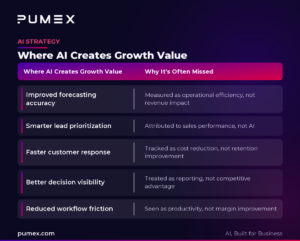
Where the Value Actually Accumulates 

The strongest AI returns rarely come from a single dramatic transformation. They come from smaller, consistent improvements across multiple operational areas, compounding quietly over time. 

Where the Value Actually Accumulates  

Each of these individually looks modest. Together, they shift the economics of how a business operates, and that shift is what turns AI from a line item into a leverage point. 

Technology Alone Still Doesn’t Deliver It 

None of this happens by buying the right tools. 

Snowflake’s 2025 research found that 92% of organizations actively using AI reported their investments paying for themselves, returning an average of $1.41 for every dollar spent. Actively using means embedded in daily operations, not sitting in a pilot. 

The organizations achieving those returns have done the harder work: process alignment, employee adoption, data governance, and clear ownership of AI outputs. That’s the difference. Not spending more. Integrating more deliberately. 

The Mindset Shift That Precedes the ROI Shift 

The companies turning AI into a profit driver didn’t get there by optimizing their cost center logic. They got there by stopping that conversation and starting a different one. 

Not what can we automate, but where do we want to compete differently in three years, and how does AI get us there? 

That question leads to use cases with revenue attached. It leads to integrations that compound. It leads to AI that feels less like overhead and more like operating advantage. 

The shift from cost center to profit driver doesn’t start with the technology. It starts with how the investment is framed, and what it’s being asked to do. 

At Pumex, that’s typically where the most useful conversations begin. If yours hasn’t started yet, it’s worth a conversation. 


Sources:  

  • PwC Global CEO Survey 2026 
  • BCG The Widening AI Value Gap, September 2025 
  • Deloitte AI ROI: The Paradox of Rising Investment and Elusive Returns, October 2025 
  • Google Cloud AI ROI Research 2025 
  • Snowflake/Enterprise Strategy Group Radical ROI of Generative AI, April 2025 

Â